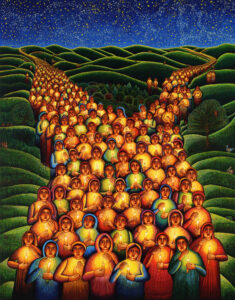
“You are the salt of the earth.”
“You are the light of the world.”
Not you should be.
Not someday you will become.
Jesus speaks in the indicative, a statement of reality, as plain as winter light off the Damariscotta River: you are.
And because you are, because this is already true, Jesus pivots immediately to the question that always follows identity: so, what difference does it make?
This Sunday’s lectionary gives us what looks like two separate teachings stitched together: first, salt and light; then, law and prophets.
They don’t seem to belong in the same breath until you notice the thread running through both: how a community interprets God’s teaching in a world that needs justice.
How we read scripture.
How we live it.
How we refuse to let it become an excuse for retreat, a weapon for control, or a set of words that never becomes flesh.
Because the temptation is real, to let faith remain in the realm of ideas, to know what is true and right and good, and still remain inert.
To be clear-eyed, and still silent.
To be morally serious, and still safely distant from the costs of discipleship.
Jesus begins the Sermon on the Mount with blessing, Beatitudes that map God’s favor in places our culture overlooks: the poor in spirit, those who mourn, the meek, those who hunger and thirst for righteousness.
Then Jesus looks at the people gathered there and says, you are not just observers of this map.
You are located on it.
You are the ones called to embody it.
And notice something else.
Jesus speaks to a plural audience—“y’all.”
No single individual is the salt of the earth or the light of the world.
A lone grain of salt is almost nothing.
A lone candle can be blown out.
Jesus is calling a community into identity and mission, together.
That matters in a moment like ours.
Many of you are carrying anger, grief, and fear about what is happening in our country, not just “politics” in the abstract, but the lived reality of vulnerable people targeted, due process treated casually, the language of “law and order” invoked selectively, and racism spoken aloud where it once hid behind euphemism.
And you are asking: What does it mean to follow Jesus now?
What does it mean to be church in a time like this?
Matthew’s Gospel was written in a time like that, when empire was not a metaphor but a daily fact.
Soldiers’ boots.
Occupied land.
The constant question humming in the air: what does God want us to do when power is abusive and the future feels unstable?
Into that anxious world Jesus preaches a sermon that is, among other things, a challenge to Israel to remember its vocation: not to become an empire, not to hide in private righteousness, not to take up the sword and become what they hate—but to embody covenant faithfulness in public life: justice, mercy, truth, and courage. So, Jesus says: salt and light.
Salt is small, ordinary, and if you’ve ever cooked without it, essential.
It preserves.
It brings out flavor.
It sharpens what is already there.
In the ancient world, salt was precious, even political.
And Jesus dares to say to a little community with no official power: You are that.
But he also warns salt can become “foolish.”
Salt can lose its capacity to do what salt is for, not because it stops being salt in name, but because it stops doing salt’s work.
That hits close to home for churches.
It is possible to have all the right statements and still be tasteless.
To have beautiful liturgy and still be inert.
To be doctrinally articulate and morally irrelevant.
It is possible to know about God and yet refuse to be the activity of God in the world.
And knowledge without action is not neutral.
Knowledge without action is how racism persists, because polite disapproval is not the same as resistance.
Knowledge without action is how the vulnerable are abandoned, because concern that never becomes embodied protection is simply a sentiment.
Salt has an edge.
It can sting.
Put salt in a wound and you feel it immediately.
Sometimes the church’s calling is to be that sting, not cruelty, not self-righteousness, but truth that wakes what has gone numb: the sting of naming what we would rather not see, the sting of confession, the sting of refusing to cooperate with what harms our neighbor.
Light, too, is not sentimental.
Light exposes.
Light reveals what has been hidden in the shadows.
Light makes it possible to see the path.
And Jesus says: a city on a hill cannot be hidden.
A lamp is not lit to be covered.
The only way our light gets covered is if we put the basket there: exhaustion (“it’s too much”), cynicism (“nothing will change”), respectability (“I don’t want to cause trouble”), fear (“what will it cost me?”), abstraction (“let’s keep it spiritual, not specific”).
But Jesus will not let us pretend we are victims of the basket.
We are not doomed to dimness.
We are commissioned to shine.
And then Matthew places right beside salt and light this teaching about the law and the prophets.
Jesus says: “Do not think that I have come to abolish the law or the prophets; I have come not to abolish but to fulfill.”
That word “law” is tricky for us, because we hear “legalism.”
But Torah is better understood as teaching, a covenant way of life meant to shape a people into a just community.
Not a ladder to earn God’s love, but a response to God’s liberating love: a way of life where widows aren’t discarded, orphans aren’t exploited, and strangers aren’t scapegoated.
And the prophets keep calling the people back.
Share your bread with the hungry, welcome the homeless poor, practice fair wages and honest scales.
So, when Jesus says he fulfills the law and prophets, he is not shrinking God’s demands into private morality.
He is intensifying the heart of Torah: mercy, justice, faithfulness, love of neighbor—and even love of enemy, which is not tolerating abuse, but refusing to be remade into the image of empire.
Then comes the line that startles, “Unless your righteousness exceeds that of the scribes and Pharisees, you will never enter the kingdom of heaven.”
This is not Jesus telling us to be more religious than religious people.
It is Jesus calling for a different kind of righteousness, not performance, not curated respectability, but covenant faithfulness that becomes actual in the world: mercy with muscle, justice with tenderness, truth with courage.
Here is the question for us, here in Newcastle, where we know small communities, harsh seasons, and how a little can matter: what would it mean for us, together, to be salt and light in this moment?
It might mean refusing the lie that faith is private.
It might mean showing up, quietly, consistently, for people in danger.
It might mean supporting legal aid or accompaniment networks.
It might mean using our credibility not to win arguments, but to protect people.
It could involve speaking the truth publicly instead of staying silent.
And it will mean guarding our own souls.
Refusing to let outrage become hatred, fear become contempt, despair become an excuse. Because the point is not to be loud.
The point is to be faithful. Salt does not scream; it seasons.
Light does not argue; it shines.
And what is the aim of this shining?
Jesus says: “so that they may see your good works and give glory to your Father in heaven.”
Not glory to the church.
Not glory to our side.
Glory to God, the God whose name is hallowed when the hungry are fed, the stranger is welcomed, the oppressed are defended, truth is spoken, mercy is practiced, and dignity is protected.
So, let’s hear Jesus’ words again as blessing and commissioning: You are the salt of the earth.
You are the light of the world.
Not because we are heroic.
Not because we are pure.
Not because we are powerful.
But because God has placed us on the map of blessing and entrusted us with a mission for the sake of the whole creation.
And if we are tempted to say, “We are too small,” Jesus smiles and says, “Yes.
Salt is small.
Light can be small.
That’s the point.”
A pinch can change a whole pot of soup.
A lamp can transform a home.
So may we be a community that does not lose its taste.
May we be a people who refuse the basket.
May we read the law and prophets through the life of Jesus, toward justice, mercy, and faithfulness.
May we be brave enough to be useful.
And may the Holy One make our common life, our worship, our money, our time, our voices, our bodies, into salt that stings what needs healing and light that exposes what needs truth, until God’s reign comes near enough to feel.
Amen.