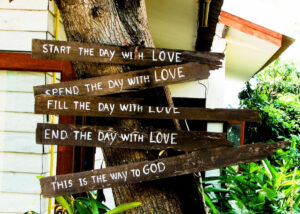
What is at the center of your life? Not what you would like to be at the center. Not what you think ought to be at the center. But what actually is. What receives your attention? What shapes your decisions? For What are you willing to sacrifice? What do you protect when you feel threatened? What do you reach for when you are afraid? Those questions may be especially close to the surface this week.
We are just days away from an election. Many of us are worried about the state of our democracy. We are worried about institutions we once assumed were sturdy. We are worried about people whose safety, dignity, marriages, families, livelihoods, or ability simply to live freely in this country feel increasingly vulnerable. And into all of that comes this question posed to Jesus: “Teacher, which commandment in the law is the greatest?” What is the center?
It is a question meant to test him. Jesus is in Jerusalem, and the conflict around him is growing. Religious leaders have been taking turns questioning him, trying to expose him, trying to diminish his authority. And Jesus answers with words that would have been deeply familiar to everyone listening. “You shall love the Lord your God with all your heart, and with all your soul, and with all your mind.” Words from Deuteronomy. Words at the heart of Jewish faith and prayer. But Jesus does not stop there. “And a second is like it: You shall love your neighbor as yourself.” And then he says something extraordinary: “On these two commandments hang all the law and the prophets.” Everything hangs on love. Love of God. Love of neighbor. Love of self. Not three competing loves, but one life ordered toward love.
And perhaps that word “hang” is worth noticing. Think of a door hanging on its hinges. Without the hinges, the door cannot function. Jesus says that everything else—every commandment, every teaching, every claim we make about faithfulness—hangs on these. If what we believe does not lead us toward love of God and love of neighbor, something has gone wrong. If our religion makes us less compassionate, something has gone wrong. If our theology makes us indifferent to suffering, something has gone wrong. If our devotion to God becomes an excuse not to care about what happens to other human beings, something has gone terribly wrong. Because love of God and love of neighbor cannot finally be separated.
And the love Jesus is talking about here is not primarily a feeling. We use the word “love” for feelings all the time. We love chocolate. We love a song. We love someone because being around them makes us happy. But the kind of love Jesus commands cannot depend on warm feelings, because Jesus asks us to love people toward whom we may feel very little warmth.
Thomas Aquinas defined love as willing the good of another. To love another person is to desire—and then to act for—their flourishing. That is harder than being nice. It means asking not simply, “What do I want?” but, “What does love require of me?” What does love require of me as a spouse or parent or friend? What does love require of me as an employer or employee? What does love require of me as someone with money? What does love require of me as someone with education, influence, citizenship, a voice, a vote? What does love require of us as a church? Those are stewardship questions.
Today we begin our annual stewardship season, and inevitably when churches use the word stewardship, people begin thinking about money. And, yes, stewardship includes money. Money matters because what we do with our money reveals something about what matters to us. But Christian stewardship is much larger than a pledge card. Stewardship begins with a much more fundamental claim: Nothing we possess is entirely our own. Our money is gift. Our time is gift. Our bodies are gift. Our intelligence and education are gifts. Our relationships are gifts. Our citizenship is gift. Our capacity to influence the lives of other people is gift. This fragile and beautiful planet is gift. Even the breath with which we say our prayers is gift.
And the question of stewardship is: What will we do with what has been entrusted to us? Jesus says: Love God. Love your neighbor. Use what you have been given for love. Which means that stewardship is not principally about financing an institution. It is about offering a life. It is about placing everything we are and everything we have at God’s disposal and asking, “How can this become an instrument of love?”
And that question matters enormously in this particular week. Because voting can be an act of stewardship. Citizenship can be an act of stewardship. Democracy itself is something entrusted to our care. A democracy assumes that we are responsible not only for ourselves but for one another. It requires us to recognize that our neighbors’ lives matter, their voices matter, their dignity matters—even when they are different from us, even when they disagree with us.
And Christians bring an even deeper conviction to that work. Our neighbor is not simply the person who looks like us or thinks like us or votes like us. Our neighbor is the immigrant and the citizen. Our neighbor is transgender and cisgender. Our neighbor is gay and straight. Our neighbor is the person who is wealthy and the person who cannot pay the rent. Our neighbor is the person whose candidate’s yard sign makes our blood pressure rise.
And loving all of them does not mean pretending that every policy is equally just or every exercise of power equally harmless. Jesus certainly does not confuse love with passivity. The Jesus we meet in this part of Matthew’s Gospel is formidable. He challenges people. He confronts hypocrisy. He overturns tables. He argues with religious authorities. Apparently, loving one’s neighbor does not mean avoiding conflict. Sometimes love requires resistance. Sometimes love requires saying, “No. You may not treat people this way.” Sometimes willing the good of another person means defending them from those who would harm them. Sometimes love means standing beside frightened people and saying, “You will not stand here alone.”
And sometimes love means examining ourselves. Because it is very easy—especially in a polarized time—to become convinced that the problem is entirely over there. They are cruel. They are ignorant. They are dangerous. And perhaps sometimes they are. But Jesus does something fascinating after answering the Pharisees’ question. He asks them one of his own. He asks about the Messiah, the Son of David, and then cites a psalm in which David calls his own descendant “Lord.”
It is a strange little riddle about authority. But beneath it lies a spiritual question: Are you capable of recognizing an authority greater than your own? Can you imagine that you might have to yield? Can you accept that even your knowledge, your status, your certainty, your righteousness must bow before God?
That matters for us too. Because even when we are right about something, we are still capable of pride. We are capable of loving justice while despising people. We are capable of defending the vulnerable while quietly congratulating ourselves on our moral superiority. We are capable of believing that because our politics are compassionate, everything about our lives must therefore be aligned with the kingdom of God. Jesus does not permit us that easy escape. Love your neighbor. And remember: your neighbor includes everyone. Which means Christian love requires both courage and humility. Courage to stand against cruelty. Humility to remember that we ourselves are not God.
Perhaps that is one of the gifts the Church can offer our anxious and divided world right now: a community where courage and humility are held together. A community where we refuse to surrender vulnerable people to the powerful. And where we refuse to surrender anyone to contempt. A community where we tell the truth. And where we remember that the people with whom we disagree remain beloved children of God. A community where justice does not become self-righteousness, and love does not become cowardice.
That is stewardship too. We are stewards of the kind of community we create. We are stewards of our words. We are stewards of our attention. We are stewards of our outrage. We are stewards of our power. We are stewards of our hope.
And that may be particularly important right now, because fear convinces us to clutch everything tightly. The Gospel teaches us to open our hands. Not because what we have does not matter, but because ultimately everything we have belongs to God. Everything is gift. And the proper response to gift is not possession but gratitude. Not fear but generosity. Not hoarding but stewardship. Love the Lord your God with all your heart and soul and mind. Love your neighbor as yourself. Everything else hangs there.
So perhaps the question for this stewardship season is not, “How much should I give to the church?” Perhaps the question is larger. What have I been given? And how might God use it for love? My money. My home. My education. My time. My citizenship. My relationships. My vote. My voice. My life.
What would happen if we stopped asking how much of those things we are willing to give to God and began with the recognition that they already belong to God? What would happen if we understood stewardship not as giving God a portion of our lives, but offering God the whole? “All your heart.” “All your soul.” “All your mind.”
Because the good news is that before God asks anything from us, God gives God’s own self to us. The God revealed in Jesus Christ does not stand at a distance demanding that we love more. God comes among us. God feeds the hungry. God touches the untouchable. God welcomes the outcast. God confronts the powerful. God gives and gives and gives—even giving God’s own life. And we love because we have first been loved.
So, in this anxious week, in this stewardship season, in this fragile moment in the life of our country and our world, may we remember what is at the center. Not fear. Not winning. Not wealth. Not party. Not even being right. Love. Love God. Love your neighbor. And then take everything God has placed in your hands—and use it for love. Amen.