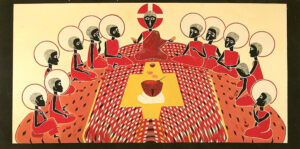
Tonight we come to one of the holiest, tenderest, and most uncomfortable nights of the Christian year. Maundy Thursday brings us into an upper room, into a borrowed space, into the final intimate hours before betrayal, arrest, violence, and death. It is a night of bread and wine. A night of basin and towel. A night of love spoken plainly and enacted concretely. A night when Jesus, knowing what is coming, chooses not to defend himself, not to explain everything one last time, not to give his disciples a theory of salvation or a final set of religious requirements. Instead, he gives them himself. He gives them a meal. He gives them touch. He gives them a commandment.
“I give you a new commandment, that you love one another. Just as I have loved you, you also should love one another.”
This is the heart of Maundy Thursday. The word “maundy” comes from mandate, from commandment. And the commandment is love. Not sentimentality. Not niceness. Not avoiding conflict. Not a vague religious feeling. Love. Jesus says these words knowing full well who is in the room. Judas is there. Peter is there. The others are there too: confused, fearful, devoted, inconsistent, sometimes brave and sometimes not. They are not a perfect community. They do not understand what is happening. Before the night is over, one will betray him, one will deny him, and the rest will scatter. And still, Jesus loves them.
That matters. Because too often we imagine that Christian love belongs only to ideal communities, to people who already agree with one another, trust one another, or know how to behave. But the first command to love one another was not given to a polished, harmonious church. It was given to a fragile and frightened community on the verge of falling apart. Which means this commandment is for us.
It is for the church as it actually is: beautiful and wounded, generous and imperfect, sometimes courageous, sometimes anxious, sometimes wonderfully faithful, sometimes very human. It is for a world as fractured as ours. It is for neighbors who do not vote the same way, who do not share the same story, who do not carry the same burdens, who do not see the world through the same eyes. It is for all of us who long for the peace of God and yet so often resist the path that leads there.
Jesus does not say, “By this everyone will know that you are my disciples, if you are right about everything.” He does not say, “if you keep yourselves pure,” or “if you win the argument,” or “if you separate yourselves from everyone you find difficult.” He says, “if you have love for one another.”
That is both simple and devastating. Because love like this is not abstract. It has to be embodied. It has to take shape in real relationships, real communities, real acts of care and courage. And that is exactly what Jesus shows us tonight. He takes bread, blesses it, breaks it, and gives it to them. He takes a towel, kneels down, and washes their feet. In other words, he teaches love not as an idea but as a practice.
The meal tells us that love gathers. Love makes room. Love feeds. Love creates communion where there might otherwise only be distance. Around this table, Jesus forms a people, not because they are all the same, but because all of them are loved. He gives them bread and wine not as magic tricks, not as rewards for spiritual achievement, but as signs of his life poured out for the world. The Eucharist is a mystery, yes, but it is not magic in the sense of bypassing our humanity. It is holy precisely because it comes to us in the ordinary stuff of human life: eating, drinking, remembering, sharing, receiving.
And it is called Communion for a reason. No one celebrates Eucharist alone. It takes a gathered body. It takes hands reaching out and voices responding and people showing up with all their joy and grief, faith and doubt, conviction and confusion. Christ meets us in the bread and wine, but Christ also meets us in one another. We become the Body of Christ together.
That means every time we come to this table, we are drawn into something larger than ourselves. We are reminded that the kingdom of God is not built on sameness or exclusion. It is built on grace. Here, all are invited: old and young, certain and uncertain, wealthy and struggling, gay and straight, trans and cis, citizen and immigrant, lifelong believer and weary seeker. The table widens because the love of God widens.
And if that is true, then Eucharist is always quietly revolutionary. Because in a world organized by scarcity, fear, hierarchy, and suspicion, Jesus gathers people to share one loaf and one cup. In a world that teaches us to sort ourselves into worthy and unworthy, insider and outsider, Jesus gives himself for all. In a world so often shaped by domination, Jesus kneels.
And that brings us to the basin and the towel. If the meal tells us that love gathers us, the foot washing tells us that love lowers itself. Love serves. Love touches what is vulnerable and human. Love refuses the illusion that some people are above others.
Peter, of course, recoils. And who can blame him? There is something almost unbearable about being served in this way by Jesus. We might imagine that the hard part of discipleship is serving others, and certainly that can be difficult. But often the first hard thing is allowing ourselves to be loved. Allowing ourselves to receive. Allowing ourselves to be touched in the places where we are weary, ashamed, defended, or afraid.
That is Peter’s struggle tonight. First, he refuses Jesus’ gift. Then he tries to manage it, to define it on his own terms. Only at last does he let Jesus wash him. And maybe that is our struggle too. Many of us know how to do, how to serve, how to organize, how to fix, how to give. Those are good things. They matter. But the gospel also asks whether we can receive. Can we let ourselves be loved without earning it? Can we allow grace to come where we cannot control it? Can we accept that we, too, need tending, cleansing, healing, forgiveness?
On Maundy Thursday, Jesus blesses his disciples through humble touch. And then he says, in effect: now go and do likewise. The blessing is not complete until it passes through us into the world. That is what makes this night so demanding. Jesus does not romanticize love. He commands it. He enacts it. And then he entrusts it to us.
Love one another, he says, as I have loved you. Love that feeds the hungry and honors the dignity of the poor. Love that refuses racism, because no one can be disposable in the Body of Christ. Love that stands with the vulnerable, because Jesus always does. Love that tells the truth, because real love is never mere politeness. Love that makes room at the table and also changes the shape of the table. Love that serves, not to display virtue, but to restore relationship. Love that can hold difference without abandoning justice. Love that knows washing feet is not only about humility, but about solidarity.
This is the love by which the world will know us. Not our buildings. Not our budgets. Not our certainty. Not even our liturgy, beautiful as it is. The world will know we belong to Jesus by the quality of our love. And on this night, that love has a particular texture. It feels like bread in the hand. It tastes like wine on the lips. It looks like water poured over tired feet. It sounds like a commandment and a promise.
For the good news of Maundy Thursday is not simply that Jesus tells us to love. It is that Jesus loves us first. He gives what he commands. He creates what he asks for. He gathers this fragile community, then and now, and makes of us a people capable of more mercy, more courage, more tenderness, more truth than we could manage on our own.
Tonight we remember that before the cross, there is a table. Before the silence of Holy Saturday, there is the sound of water in a basin. Before the horror of Good Friday, there is this commandment: love one another.
And tonight, we are invited not just to observe this story but to enter it. To let ourselves be loved. To let ourselves be blessed. To let that blessing undo us and remake us. And then to go from this place ready to love as Jesus loved: concretely, bravely, humbly, and together. For this is our mandate. This is our calling. This is the way of Christ. “Just as I have loved you, you also should love one another.” Amen.