Much of life teaches us the importance of saving. We save money for a rainy day. We conserve our energy, protect what we have worked hard to acquire, avoid unnecessary risks, and plan carefully for the future. And there is wisdom in all of this. Being careful with our resources is often a sign of responsibility and good judgment.
But this morning, Jesus tells us a disturbing story about a man who was so afraid of losing what he had been given that he buried it in the ground. And when his master returned, the servant discovered that playing it safe was not what had been expected of him.
Which raises an uncomfortable question: What if the greatest spiritual danger is not that we might waste what we have been given, but that we might become so concerned about holding on to it that we forget what it was given to us for in the first place? Or, to put it another way: What if the purpose of all that we have been given is not to help us hold on to life, but to help us give ourselves away in love?
That’s a question worth pondering at any age. But perhaps it becomes especially meaningful as we grow older, when we begin to realize that there are more years behind us than ahead of us—and when the question of what we will do with the time we have left takes on a new urgency.
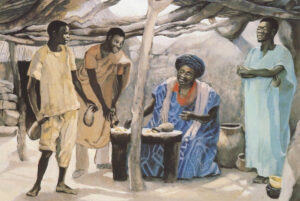
In the parable, a wealthy man preparing for a journey entrusts three servants with extraordinary sums of money. A talent was not a personal ability, as we use the word today, but an amount worth perhaps fifteen or twenty years of a laborer’s wages. Even the servant who receives just one talent is being entrusted with a fortune. The first two servants put the money to work, take risks, and double what they have received. The third digs a hole and buries his master’s money.
In the ancient world, burying valuables was a reasonable way to protect them. This servant doesn’t steal or squander anything. When his master returns, he can truthfully say, “Here you have what is yours.” But the master is furious. The first two hear, “Well done, good and trustworthy servant … enter into the joy of your master.” The third is condemned for his failure to act.
Before moving too quickly toward a reassuring interpretation, however, we need to acknowledge something troubling about this story. The master is an enormously wealthy slaveholder who expects substantial profits. When the third servant fails to produce them, he orders him cast into the outer darkness, where there is weeping and gnashing of teeth. Is this really how Jesus wants us to imagine God?
Traditionally, Christians have understood the master as representing Christ, who entrusts his followers with responsibilities, departs, and eventually returns to hold them accountable. That makes sense in Matthew’s Gospel, where Jesus is preparing his disciples to live faithfully during his absence. But a parable is not a photograph of God. Jesus uses imperfect human characters to illuminate God’s kingdom. We need not assume that every characteristic of this master reflects God’s character.
Notice that it is the third servant who describes the master as harsh and demanding. We hear that description from someone who is afraid. And the master’s response seems to expose an inconsistency: If you believed I was so demanding, why didn’t you at least do something with what I entrusted to you? Perhaps the decisive issue is not the demand for profits, but the servant’s fear and the paralysis it produces.
The severity of the ending remains, and we should not erase it. Matthew insists that our choices have consequences. But neither should we let a harsh master eclipse what Jesus teaches us about God’s mercy. In the very next passage, Jesus says that what matters is whether we feed the hungry, welcome the stranger, and care for those in need. Whatever else we make of this parable, we must read it in the light of the Jesus who gave himself away in love.
The third servant sees what he has received not as an opportunity, but as a responsibility that might get him into trouble. Fear becomes the governing principle of his life. “I was afraid,” he says, “and I went and hid your talent in the ground.” Perhaps those three words, I was afraid, bring us to the heart of the story.
Fear shrinks our world. We become afraid of mistakes, of loss, of disappointment, of looking foolish, of discovering that our efforts won’t matter. And so we hold back. We protect our resources, our reputations, and sometimes our hearts against the vulnerability love requires. We can become so concerned about not losing anything that we risk giving nothing.
But consider Jesus himself. As he told this parable, he was approaching the final days of his life in Jerusalem, where his teaching and actions threatened established powers. He risked rejection, misunderstanding, and ultimately his life for the sake of love. He touched those others considered untouchable, welcomed the excluded, and challenged systems that protected privilege while neglecting the vulnerable. He did not cling to his life as something to be preserved at all costs. He gave it away. And perhaps that is the deepest challenge of this parable.
We have been entrusted with precious lives: gifts we did not earn, relationships that have shaped us, and resources that might serve purposes larger than ourselves. The question is not simply how carefully we have protected these gifts, but what we are doing with them.
That question takes on particular urgency in the later years of life. As we grow older, our energy may diminish, our bodies impose new limitations, and opportunities we once took for granted may disappear. These are real losses, and they deserve to be acknowledged. But aging can also bring a certain freedom. We may feel less need to impress others, accomplish great things, or prove ourselves. We may have learned something about what truly matters.
And perhaps the invitation now is not to do more, but to live more freely—to be more generous with what we have, more courageous in our compassion, and less afraid of giving ourselves away. For some, that may mean sharing wisdom with a younger generation, supporting a cause we believe in, or speaking out against injustice. For others, it may mean a phone call to someone who is lonely, the courage to forgive an old hurt, or the grace to receive another person’s care. The point is not that we must keep accomplishing things to justify our existence. Our worth has never depended on what we can produce. But whatever our circumstances, we are still invited into the life of love. And sometimes the quietest expressions of that love are among the most profound.
There is a seriousness to this parable. Our choices matter. How we use our resources matters. A life devoted primarily to self-protection can become a very small life indeed. Yet I don’t believe Jesus is asking us to live anxiously, wondering whether we have done enough to satisfy a demanding God. That would only replace one kind of fear with another. Instead, I hear an invitation to trust that life is a gift, given not merely to be guarded, but to be shared. So perhaps the question is not, “What more must I accomplish before my life is over?” but “How can I make the life I have, with all its limitations and possibilities, an expression of love?”
I keep returning to those beautiful words spoken to the first two servants: “Enter into the joy of your master.” Not the joy of achieving the highest return on an investment, or of a life carefully protected against mistakes and losses. But the joy of participating in something larger than ourselves. The joy of knowing our lives have contributed to the flourishing of others. The joy of loving, even when love involves risk. The joy of giving something of ourselves away.
Perhaps that is what Jesus ultimately wants us to discover: the life we are so anxious to preserve becomes fullest when we are willing to share it. Whatever years remain before us are not simply years to be managed, protected, or endured. They are years in which we can continue to love, to give, and to participate in God’s work of healing the world.
So perhaps the question to carry home this morning is this: What am I still holding tightly that could become a gift to someone else? For the invitation of the gospel is not simply to do more. It is to live more freely, love more courageously, and give more generously of the precious lives entrusted to us. And in doing so, perhaps we will discover that the joy of our master is not only something awaiting us at the end. It is something we can begin to enter, here and now. Amen.