“Do not be afraid.” Jesus says it three times in this passage. And whenever Scripture repeats itself, we should probably pay attention.
“Do not be afraid.” It sounds comforting. It belongs on a greeting card, perhaps, or embroidered on a pillow. But in this chapter of Matthew’s Gospel, Jesus is not speaking to people whose lives are peaceful and secure. He is sending his disciples out as sheep among wolves. He has warned them that they may be arrested, publicly humiliated, betrayed, and hated. He has told them that even the most intimate relationships of their lives may be strained by their allegiance to the reign of God.
And then Jesus says, “Do not be afraid.” He does not say this because there is nothing to fear, but because there is much to fear—and fear must not rule us. Christian courage is not optimism, the assumption that everything will turn out well, or denial clothed in religious language. Courage does not look at a gathering storm and pretend the sky is clear. It tells the truth about the storm. It calls political intimidation by its name. It recognizes the targeting of immigrants, transgender people, racial and religious minorities, and all whose safety is treated as negotiable. It sees public institutions corrupted, democratic norms dismissed, and cruelty made ordinary. It does not minimize threats simply because naming them would make coffee hour uncomfortable. “Do not be afraid” does not mean “Do not look.” It means look clearly, speak truthfully, and do not let what you see paralyze you.
Fear has always been useful to those who seek power. It can be cultivated through suspicion of strangers, anxiety about change, the loss of status, scarcity, and the false belief that another person’s freedom diminishes our own. Fear shrinks the moral imagination. It convinces us that safety matters above all else, teaches us to accept what we once would have resisted, and draws us into private life, hoping the world’s troubles will pass by our door. Fear whispers, “Keep your head down.” Jesus says, “What I say to you in the dark, tell in the light; and what you hear whispered, proclaim from the housetops.”
Of course, our fears are not only political. Many of us know the anxieties that come with aging: losing our health, memory, or independence; becoming a burden; watching our world narrow as driving becomes harder, friends die, institutions change, and our bodies grow less reliable. We may also fear for this congregation. Will there be enough people, money, and energy? Who will carry on the ministries we cherish? What will become of the Church we love?
We fear for children and grandchildren inheriting a climate altered by our consumption, a democracy weakened by our failures, and a public life made coarser by our silences. Jesus does not promise us control over any of this. He does not say that nothing painful will happen. He does not say that faithful congregations will always flourish, that democratic institutions will always endure, or that our bodies will be spared the ordinary losses of mortality. He gives us something other than control.
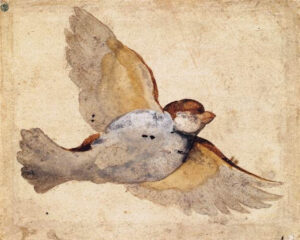
“Are not two sparrows sold for a penny?” Jesus asks. “Yet not one of them will fall to the ground apart from your Father.” Sparrows were common, cheap, and easily overlooked. Yet Jesus says not even one falls outside God’s care. This does not mean sparrows never fall; it means nothing falls beyond God’s sight. No life is disposable. No suffering is too small for God to notice. No person dismissed by society is insignificant to God. “You are of more value than many sparrows.” Your worth does not depend on productivity. It does not diminish when you can no longer do what you once did. It is not measured by independence, income, memory, or physical strength. You are seen. You are known. You are held. And because we are held by God, we may loosen our frantic grip on self-preservation. We may risk faithfulness.
Then Jesus says the sentence many of us wish he had not said: “Do not think that I have come to bring peace to the earth; I have not come to bring peace, but a sword.” These are dangerous words when removed from their context. Christians have too often used isolated verses to bless violence, division, and domination. But Jesus is not placing a weapon into his disciples’ hands. Later, when Peter draws a sword in Gethsemane, Jesus tells him to put it away. The sword in this passage is not a weapon Christians are commanded to wield. It is an image of the division that occurs when the truth of God confronts an unjust arrangement of the world.
There is true peace, and there is false peace. True peace is reconciliation, justice, dignity, and right relationship—the shalom of God. False peace depends on silence: the dinner party where no one names the excluded guest, the institution that avoids controversy while vulnerable people pay the price, the family that stays harmonious only because abuse remains unnamed, and the nation that calls itself orderly because suffering has been pushed out of sight. The prophets warned against those who cried, “Peace, peace,” when there was no peace. Jesus refuses that peace.
This may be particularly challenging for progressive Christians. We rightly value dialogue, nuance, and civility. We know that self-righteousness can become its own form of violence. We are wary of religious certainty because we have seen the damage it can cause. But sometimes our love of nuance becomes an excuse for moral hesitation. Sometimes civility means that the person doing harm remains comfortable while the harmed person is asked to wait. Sometimes we speak so carefully that no one can tell what we believe.
Civility is a virtue. It is not the highest virtue. The highest command is love. And love sometimes must say clearly: This is wrong. This policy is cruel. This person is being scapegoated. This institution is failing its purpose. This silence is becoming complicity. Truth may divide—not because division is holy, but because those who benefit from injustice rarely welcome its exposure. The peace of God is not merely the absence of conflict. It is the presence of justice. Peacemaking may therefore create conflict before it creates reconciliation.
Jesus then says, “Whoever does not take up the cross and follow me is not worthy of me.” We should be careful with these words. The cross is not whatever makes life difficult. A bad hip is not necessarily “your cross.” Neither is an irritating relative, an unwelcome diagnosis, or the ordinary grief of growing older. Those things may require patience, courage, and faith. God is certainly present in them. But in Matthew 10, taking up the cross has a more particular meaning. The cross is the suffering that can come from following Jesus’ mission: telling the truth when silence would be safer, standing with those society rejects, refusing complicity in cruelty, and confronting powers sustained by fear and domination.
The Roman cross was not an abstract symbol of hardship. It was an instrument of state terror. Rome used crucifixion against enslaved people, rebels, and those who threatened imperial order. Before the cross became jewelry, it was an indictment of empire. To take up the cross is not to romanticize suffering. It is certainly not to tell victims of abuse to remain where they are and call their victimization holy. Oppression is not a cross God assigns to the oppressed. Jesus does not command passive submission to evil. The cross is not submission to oppression. It is solidarity with those oppressed by the powers that crucified Jesus.
Jesus does not ask us to seek suffering. He asks us to seek the kingdom of God so faithfully that we become willing to accept the cost. For some of us, that cost may be financial. We may have to surrender some comfort so that others may live. For others, it may be social. We may have to risk tension in a friendship or family because we will not participate in contempt masquerading as humor. It may be institutional. A church that speaks clearly may lose members or donors. It may be reputational. People may call us partisan when we defend the dignity of those whom partisans have chosen to target.
Of course, offense alone does not mean we are following Jesus; anyone can be offensive. The real question is not whether conflict has arisen, but why. Are we protecting our ego or pursuing justice? Are we speaking from contempt or love? Are we trying to defeat an enemy, or to make liberation possible for everyone, including those captive to their own need to dominate?
Jesus says, “Those who find their life will lose it, and those who lose their life for my sake will find it.” Perhaps the great temptation of a congregation like ours is to spend our remaining years protecting what we have built. But the Church does not exist merely to preserve itself. We have not been entrusted with buildings, endowments, liturgies, education, and influence so that they may remain safely in our possession. We have been given these things so that we may give them away in service to God’s world.
The question is not simply, “How do we keep the Church alive?” The question is, “For whom is this Church willing to spend its life?” We do not know what the future will bring. We do not control the fate of the nation, the climate, our bodies, or even this congregation. But we are not powerless. We can refuse to look away. We can speak what has been whispered. We can interrupt the false peace that conceals suffering. We can place ourselves beside those who are treated as expendable. We can use the resources, education, experience, and social standing we possess—not to insulate ourselves, but to protect the vulnerable and enlarge the circle of human dignity. We can take up the cross—not as passive sufferers, but as active participants in Christ’s liberating work.
And when fear comes, as it surely will, we may speak to it gently but firmly: You are real, but you are not my master. For every sparrow is seen. Every hidden truth will be uncovered. Every act of mercy matters. And even when faithfulness costs us the life we had planned to preserve, Jesus promises that in giving ourselves to God’s work, we will discover a life deeper, freer, and more abundant than the one fear told us to protect. So do not be afraid. Amen.