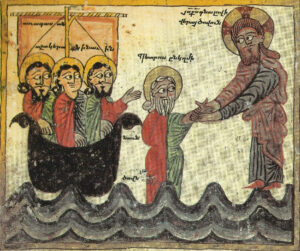
Immediately after feeding a multitude with five loaves and two fish, Jesus makes the disciples get into a boat. “Make” is almost too gentle a word. The Greek verb suggests that Jesus compelled them, constrained them, practically forced them into the boat. This is not a pleasant invitation to take an evening cruise. Jesus puts them in the boat and sends them out onto the water.
And before long, the wind rises. The boat is battered by the waves. The disciples struggle through the night. They pull at the oars, fight the wind, and exhaust every skill and resource they possess. Some of them are experienced fishermen, but even experienced fishermen can reach the limits of their experience. Even capable people eventually discover that capability is not the same thing as control.
Then, sometime between three and six in the morning, Jesus comes toward them, walking across the sea. The disciples are terrified. They assume that what they are seeing must be a ghost. They cannot imagine another possibility. Jesus calls out, “Take heart, it is I; do not be afraid.”
A more literal translation is, “Take heart. I AM. Do not be afraid.” I AM: the name of God revealed to Moses. I AM: the God who brings creation out of chaos. I AM: the God who makes a path through the sea. I AM: the God whose presence means that the world is not limited to what frightened human beings believe is possible.
Peter answers, “Lord, if it is you, command me to come to you on the water.” And Jesus says, “Come.” Peter climbs out of the boat. For one astonishing moment, Peter lives in a world he had never imagined possible. He steps onto the water, and the water holds him. He moves toward Jesus, participating in the life and power of God.
Then Peter notices the wind. Of course, the wind had been there all along. The waves had been there all along. The danger was not new. What changed was Peter’s perception. For a moment he had inhabited God’s new world. Then he looked around, remembered everything he had been taught about what was possible, and became trapped again within the limits of ordinary human expectation.
Peter was unable to sustain the imagination of God’s new world. And perhaps that is our problem too. We have lived so long within the world as it is that we have difficulty imagining the world as God would have it be. We confuse the present arrangement of things with reality itself. We assume that because something has been one way for a very long time, it must always be that way.
We assume that resources must be scarce, that life must be a competition, and that there must be winners and losers. We assume that some people will possess far more than they could ever use while others will not have enough food, shelter, medicine, or safety. We assume that poverty is inevitable, that famine is unavoidable, and that exclusion is simply part of human nature. We assume that the survival of the fittest is the only principle by which societies and economies can function. We assume that endless accumulation is necessary, even when that accumulation impoverishes our neighbors and damages the planet. We see the wind. We see the waves. We see the world as it has been organized, and we conclude that this is the only world that can exist. But Jesus is walking on the water. Jesus is revealing that another world is possible.
In fact, immediately before this story, Jesus has already shown the disciples what God’s world looks like. A hungry multitude gathers in a deserted place. The disciples look at the crowd and see scarcity. “There is not enough,” they say. “Send these people away.” That is the logic of the world as it is: There is not enough, so somebody must be excluded. Jesus refuses that logic.
“You give them something to eat,” he says.
The disciples see five loaves, two fish, and thousands of hungry people. Jesus sees a feast. The disciples see insufficiency. Jesus sees abundance. The disciples imagine a world in which everyone must fend for themselves. Jesus creates a community in which everyone is fed.
Then Jesus sends the disciples into the boat as though to ask, “Did you understand what you just saw? Can you imagine that world continuing beyond this meal? Can you trust that the generosity of God is more real than the scarcity you have been taught to fear?”
Peter tries. For a moment, he steps into God’s world. Then the old world reasserts itself. The wind says, “This cannot be done.” The waves say, “This is not how reality works.” Fear says, “Return to what you know.”
We hear those voices too. We hear them whenever someone suggests that every person should have access to health care. We are told it is unrealistic, too expensive, or impossible to organize. Yet we rarely ask why providing medicine to sick people should be considered an impossible dream rather than a basic expression of love.
We hear those voices whenever someone suggests that humanity might work together across borders to confront climate change, embrace alternative energy, and preserve the earth for future generations. We are told that cooperation is naïve, that economic growth must come first, and that sacrifice is politically impossible.
We hear those voices whenever people dream of systems that no longer discriminate based on race, gender, disability, class, sexuality, or national origin. We are told that inequality is natural, that injustice is too deeply rooted, and that someone else’s inclusion must somehow mean our deprivation.
We even hear these voices in our debates about transgender people, gender-affirming care, and participation in sports. Too often, we can imagine sport only as competition: competition for victory, status, scholarships, professional contracts, and money. Within that narrow imagination, every participant becomes a potential threat to someone else’s advancement.
But what if sport—especially for children and young people—is also about friendship, physical health, teamwork, belonging, cooperation, joy, and play? What if the purpose is not simply to defeat another person, but to build community with them? What if welcoming a transgender young person onto a team allows someone who has felt isolated to experience friendship, dignity, and delight? What if gender-affirming care is about helping a young person who is struggling to become whole? What if the question is not, “How do we protect the world as it has always been?” but, “How do we help every child flourish?” The imagination of God’s kingdom asks different questions.
What if removing barriers based on gender and race allows gifts to emerge that the world desperately needs? What if someone presently excluded from education, employment, leadership, medicine, science, or public life carries an insight that could help cure a disease, address climate change, reconcile communities, or alleviate suffering? What gifts are we losing because our imagination is too small? What possibilities are sinking because we are more committed to defending the boat than following Jesus onto the water?
To sustain the imagination of God’s new world, we must return again and again to the Gospels. There, Jesus shows us what God desires. The hungry are fed. The sick are healed. The excluded are welcomed. The outcast is touched. The foreigner is praised. The sinner is restored. The prisoner is remembered. The powerful are challenged. The poor are blessed. Those pushed to the margins are brought into the center, and those accustomed to the center are invited to discover life alongside them.
This is not an abstract dream. It is the world Jesus announces, embodies, and calls us to enter. But we should not turn this story into another demand that we summon enough courage, maintain perfect faith, or imagine God’s kingdom through sheer spiritual effort. That would transform the Gospel into advice: “Try harder. Be braver. Never doubt.”
Peter cannot sustain his faith. Neither can we. Peter begins to sink. So do we. And when he cries, “Lord, save me,” Jesus does not lecture him from a distance. Jesus does not wait for Peter to demonstrate better theology. Jesus does not demand that Peter pull himself together. Matthew says, “Jesus immediately reached out his hand and caught him.” Immediately. Before Peter can disappear beneath the water, Christ’s hand is already there.
Our hope is not that we will always have enough courage to walk upon the waves. Our hope is that the One who calls us into God’s future will not abandon us when our imagination fails. Jesus will catch us. Jesus will raise us. Jesus will return us to the community. And then Jesus will invite us to try again.
The world as it is insists that there is not enough. Jesus says, “You give them something to eat.” The world as it is says that some people must remain outside. Jesus welcomes them to the table. The world as it is says that fear is realism. Jesus says, “Take heart.” The world as it is says that chaos has the final word. Jesus walks across the chaos and declares, “I AM.”
Perhaps the task before the Church is to become a community in which the imagination of God’s world is practiced and strengthened: a place where we share resources, cross boundaries, listen to those who have been excluded, care for creation, welcome children, honor human dignity, and refuse the lie that another person’s flourishing threatens our own.
We will not do this perfectly. Sometimes we will step forward. Sometimes we will sink. Sometimes we will see God’s new world clearly, and sometimes the wind will terrify us. But the hand of Christ will remain extended.
“Come,” Jesus says. Come beyond the limits of what you have been taught is possible. Come imagine a world in which everyone has enough. Come imagine a world in which difference is not feared but received as gift. Come imagine a world in which the earth is cherished, the hungry are fed, the sick receive care, the imprisoned are freed, and every human being has the opportunity to flourish. Come step out of the boat. And when you begin to sink, cry out. The One who walks upon the waters is already reaching for you. Amen.