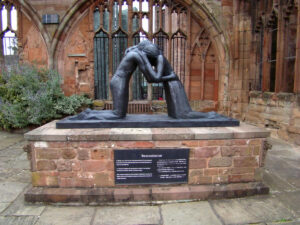
Peter comes to Jesus with what sounds like a practical question. “Lord, if another member of the church sins against me, how often should I forgive? As many as seven times?”
It is such a human question. How many times? How long do I have to keep doing this? When have I done enough? Peter probably thinks seven is a generous number. And it is. Seven carries a sense of fullness and completeness. Peter is not proposing stinginess. He is trying to be faithful.
Surely seven times is enough.
But Jesus says, “Not seven times, but seventy-seven times.” In other words: Peter, put away the calculator. Stop counting. Because the moment we begin counting acts of forgiveness, we are still living in the world of the ledger. We are still keeping accounts. We remember what was said. We remember who apologized and who did not. We remember who disappointed us last time and the time before that. We remember what happened at the vestry meeting, at the family gathering, at the office, at the kitchen table. We are extraordinarily good bookkeepers when it comes to the failures of other people. And Peter wants to know when the account can finally be closed.
Jesus answers with a story. There is a servant who owes a king an unimaginably large amount of money. Not simply a large debt, but an absurd one. Impossible. Jesus deliberately exaggerates it beyond anything a human being could ever repay. The servant falls to his knees. “Have patience with me, and I will pay you everything.” Of course he cannot. And both he and the king know it.
But then something astonishing happens. The king forgives the debt. He does not reduce it. He does not renegotiate it. He does not set up a payment plan. He simply cancels it. The servant walks away free. And this is the moment when the story might have become beautiful. Because something entirely new has entered the world of the parable. Grace. For one moment, the usual rules no longer apply. The books are closed. The debt is gone. The future is open. A different world has suddenly become possible.
And then the servant walks outside. He sees another servant who owes him a much smaller amount. And he grabs him by the throat. “Pay what you owe.” The second servant falls down and says almost exactly what the first servant had just said. “Have patience with me, and I will pay you.” But this time there is no mercy. The first servant has him thrown into prison. And that, I think, is the tragedy of this parable.
The first servant has been given the chance to live in a new world. And he chooses the old one. For a moment he has experienced a world in which mercy is greater than debt. He could have carried that mercy with him. He could have allowed it to spill over into another life, and perhaps from that life into another. Grace could have begun to move through the whole system. But it does not. The revolution ends at the door. The servant walks straight back into the familiar world of debt and punishment, power and fear, keeping score and getting even.
And perhaps that is why this parable matters so much. Because Jesus spent his life trying to convince people that another world is possible. He called it the Kingdom of God. The Kingdom of Heaven. And we have heard those words so often that perhaps we no longer hear how radical they are.
When Jesus speaks of the Kingdom of God, he is not simply talking about where we go when we die. He is speaking about God’s dream for this world. A world ordered according to the heart of God. A world in which the hungry are fed and the lost are sought, the vulnerable matter, power is used not to dominate but to serve, enemies might become neighbors, debts do not control the future.
And Jesus keeps trying to wake us up to that world. Again and again, he takes what we have accepted as normal and turns it upside down. Blessed are the poor. Love your enemies. The last will be first. Welcome the child. Leave the ninety-nine and search for the one who is lost. Forgive seventy-seven times. Again and again, Jesus is saying: You think the world has to work this way. It does not. There is another way to live.
And perhaps that is one of the hardest things for us to believe. Because we know this world so well. We know how grievance and resentment work. We know how communities divide themselves into camps and how quickly disagreement becomes contempt. We know that nations answer violence with violence and that political life can feed on anger. We know that economies keep careful records of what is owed. We know how naturally human beings sort one another into the deserving and undeserving, the innocent and guilty, the winners and losers, us and them.
We know this world. And we have become very accustomed to it.
Then Jesus comes along and says: There is another way of living and moving and having your being. Imagine that. Imagine a community in which mercy is not weakness. Imagine a society in which admitting we were wrong does not mean humiliation. Imagine public life in which defeating an opponent is less important than seeking the common good. Imagine nations courageous enough to interrupt ancient cycles of vengeance. Imagine churches where disagreement does not automatically mean division. Imagine families in which one old wound does not have to determine every remaining chapter of the story. That is the world Jesus is inviting us to see. And forgiveness is one of the practices that makes that world visible.
Now, I need to say something very important. Forgiveness does not mean pretending that harm did not happen. It does not mean remaining in an abusive relationship. It does not mean silencing anger or denying injury. It does not mean placing someone back in danger. Forgiveness does not eliminate accountability. Matthew 18 as a whole is quite clear about that. Jesus has just been speaking about confronting wrongdoing and taking harm seriously. Justice matters. Truth matters. Consequences matter. Forgiveness and accountability are not opposites.
But Jesus refuses to allow justice to become simply another word for vengeance. Forgiveness says: What happened matters. But what happened will not be given absolute authority over the future. And that may be one of the deepest forms of freedom forgiveness offers. It loosens the past’s grip on tomorrow. That does not happen easily. Sometimes forgiveness comes slowly. Sometimes it has to happen from a distance. Sometimes the relationship cannot be restored to what it once was. Sometimes wisdom requires new boundaries. And sometimes we discover that the forgiveness we thought we had accomplished yesterday has to be chosen again today.
Perhaps seventy-seven times refers not only to how often we forgive another person. Perhaps it is also how many times we ourselves have to begin again. Because forgiveness is rarely one grand, heroic decision. More often it is a practice. A discipline. A way of slowly refusing to let bitterness become our identity. A way of refusing to let the wound become the whole story. And perhaps that practice becomes possible when we remember that we ourselves live by grace.
That is what the first servant never understands. He receives mercy, but the mercy never gets inside him. He thinks he has escaped punishment. He does not realize that he has been invited into a different way of life. And there is a great difference between those two things. Grace is not simply God letting us off the hook. Grace is God drawing us into a new kind of relationship. It is God saying: You do not have to live by fear. You do not have to live by scorekeeping. You do not have to live by retaliation. You do not have to be imprisoned by the worst thing you have done or the worst thing that has been done to you. There is another way.
Every one of us has been loved more than we earned. We have been given second chances. People have been patient with us. Someone has forgiven us. And beneath all those human mercies is the mercy of God. Grace is not meant to stop with us. It is meant to move through us. And perhaps that is one reason the church exists. Not because Christians are morally superior people. History has certainly relieved us of that illusion. The church exists, at its best, to become a small, imperfect demonstration of God’s dream. A place where another way of living is practiced. We practice mercy. We practice telling the truth. We practice accountability without humiliation. We practice reconciliation. We practice beginning again. We practice treating another human being as more than the sum of their failures. We practice believing that a broken relationship, a broken community, even a broken world, does not necessarily have to stay broken.
The church does not create the Kingdom of God. But we can point toward it. We can make it visible from time to time. In a forgiven debt. In an old resentment finally released. In an apology sincerely offered. In an enemy seen again as a human being. In a community that refuses to let disagreement become hatred. In the courageous decision not to return injury for injury. Small things, perhaps. But every time mercy interrupts the old cycle, something of God’s future enters the present.
And that is what Jesus is asking Peter—and us—to imagine. Not simply, “Can you become a little more forgiving?” But: Can you imagine a world no longer governed by the ledger? Can you imagine relationships no longer ruled by the need to get even? Can you imagine that mercy might be stronger than vengeance? Can you imagine that the past need not dictate the future? Can you imagine that another world is possible?
Jesus could. Jesus did. And he spent his life inviting people into it. So perhaps the question for us is not really Peter’s question: “How many times must I forgive?” Perhaps the deeper question is: Which world do I want to live in? The world of the servant, where every debt is remembered and every wrong eventually comes due? Or the world Jesus keeps placing before us—the world of grace, mercy, truth, reconciliation, and new beginnings? That world is not easy. But it is possible. And every time we choose to live as though it were true, the Kingdom of God comes a little nearer. The old world loosens its grip. And God’s dream begins, even now, to take flesh among us. Amen.