Today the Church does something rather strange. We celebrate Christ the King. For those of us who are not especially nostalgic for monarchy, that title can be unsettling. Kings have ruled through armies, borders, taxes, and prisons. They have decided who belongs, whose voice counts, and who can be sacrificed for the security of the realm. So why call Jesus a king? Perhaps because Christianity, at its best, takes the language of power and turns it inside out.
The earliest Christians lived under Roman rule. Rome called its emperor lord and savior and announced imperial victories as good news. Its rulers promised peace, although often that peace was simply the silence of conquered people. To confess “Jesus is Lord” was to dispute Rome’s claim to ultimate authority. But the point was not that Jesus would become a more powerful Caesar. The point was that Caesar had misunderstood power altogether.
Today’s Gospel opens as though we are about to witness an imperial spectacle. The Son of Man comes in glory. He sits upon his throne. All the nations are gathered before him. And he judges them, separating sheep from goats. There is no avoiding that word: judgment. We might prefer to hurry past it and concentrate on the familiar invitation to feed the hungry and welcome the stranger. But if we do, we lose the force of the story. Jesus is not offering a collection of admirable charitable activities. He is declaring that the world as we have organized it will be called to account.
And the evidence in this judgment is astonishing. The king does not ask the nations about their military strength, economic success, or religious prestige. He speaks instead of hunger and thirst, of strangers and prisoners, of bodies left without clothing or care. The lives the world treats as peripheral stand at the very center of God’s judgment. “I was hungry,” the king says. “I was a stranger.” “I was sick.”
Notice what Jesus does not say. He does not say, “I sent you unfortunate people to test your generosity.” He says that, in some mysterious and unsettling way, he himself was present in them. It is as though the great courtroom of history has been turned around. The people ordinarily judged by society—the poor, the imprisoned, the stranger—are revealed as the people whose treatment exposes the truth about society itself.
Kat Armas, in Liturgies for Resisting Empire, describes empire as more than military force. It is a way of seeing the world: dividing humanity into insiders and outsiders, imagining security through control, measuring worth by wealth and usefulness. Empire convinces us that some lives can be ignored so others may flourish. The judgment of Christ tells the truth about that arrangement. It strips away the explanations we offer for why suffering is inevitable, why exclusion is necessary, why our comfort must be protected. What seemed normal may be revealed as cruelty. What seemed insignificant may prove to have mattered eternally.
This is why judgment can be good news—especially to those who have been wounded by the world’s indifference. A God who never judges would be a God who never finally says that cruelty is wrong. A God who simply forgives every injustice without confronting its consequences would leave the injured to carry their wounds alone. Love must be capable of saying no. God’s judgment is that holy refusal to accept a world in which some people are treated as disposable.
But judgment is also profoundly uncomfortable for people like us. We may have been blessed with education, relative security, and enough resources to make choices others cannot make. Those blessings are not themselves a verdict against us. But they do give us responsibility. We have the capacity to help, the freedom to look away, and often the means to keep suffering at a distance.
We can be informed about poverty without knowing anyone who is poor. We can support humane immigration policies without ever having welcomed a newcomer into our lives. We can give generously to organizations serving prisoners while never asking what kind of justice our prisons actually accomplish. Today’s Gospel asks not only, “Have you done something kind?” but, “What have you learned not to see?” And, “What arrangements have made it easy for you not to see?”
There is another unsettling feature of the story. Both groups are surprised. “Lord, when was it that we saw you?” ask the sheep. The goats ask essentially the same question. Neither group recognized the king.
The righteous were not earning points toward heaven. They were responding to need without knowing that Christ stood before them. The condemned were not consciously announcing their rejection of God. They failed to recognize God in people they had learned to overlook.
That is a more searching judgment than any checklist of good deeds. It concerns the kind of people we are becoming, the habits of attention we have cultivated, the boundaries of our compassion.
Yet now we encounter the hardest part of the passage. Jesus speaks of separation, of eternal fire and eternal punishment. How can a Gospel that overturns the logic of domination end with such fearsome imagery? Are we simply replacing the punitive emperor with a divine one?
We should not pretend those verses are not there or claim that we know precisely what eternity holds. Christians have disagreed about their meaning, and the words remain severe. Matthew does not offer us an easy resolution. But neither should we use them to imagine ourselves safely among the sheep, with permission to consign our enemies to the goats. Jesus gives us this story to awaken our conscience, not to appoint us judges of other people’s souls.
Armas contrasts punitive justice, which seeks to make wrongdoers suffer, with restorative justice, which seeks truth, accountability, repair, and the healing of relationships. We need not pretend that Matthew’s scene of final separation is a description of restorative justice. It is not. Yet the distinction helps us ask what divine judgment is for.
God’s judgment is not simply a more terrifying version of human vengeance. It is the disclosure of truth: the full truth about the harm done, the suffering ignored, and the people whose humanity was denied. No genuine reconciliation is possible without such truth. Mercy that refuses to name injustice is not mercy to its victims.
And the Gospel refuses to let us imagine that judgment is only about other people. There is something of the sheep and something of the goats in most of us: moments of openhearted generosity, moments of deliberate blindness. We need both the judgment that reveals our complicity and the grace that makes change possible.
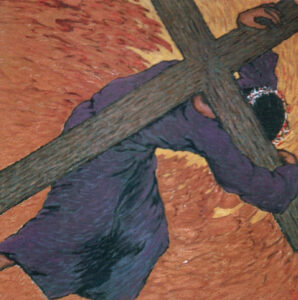
The placement of this Gospel matters. Immediately after Jesus’ final teaching comes the account of his betrayal and crucifixion. The glorious king will stand powerless before a Roman governor. He will be stripped, mocked, and executed as a threat to imperial order. The one who judges the nations is the very one who has endured their violence. He knows the suffering of those whom the powerful discard—not as an observer, but from within. And in the resurrection, Christians proclaim that the empire’s verdict is not God’s verdict. The cross, intended to prove that Rome had the final word, becomes the sign that love outlasts domination. So, this feast does not give us a heavenly emperor to admire. It gives us a crucified king whose judgment exposes the ways we betray one another—and whose mercy calls us into a different way of living.
In a few moments we will come to the Eucharist with empty hands. We will not come as the deserving sheep, congratulating ourselves on what we have done. We will come as people who need mercy, nourishment, forgiveness, and the courage to begin again. Then we will be sent out to practice what we have received: to feed, to welcome, to visit, to listen, and also to question the systems that leave so many hungry, excluded, and forgotten.
Christ the King Sunday proclaims that the world will not finally be judged by the standards of empire. It will be judged by the one whom empire crucified. And that judgment is both warning and promise: warning that our indifference matters, and promise that no suffering, no forgotten person, no act of love is invisible to God. Amen.