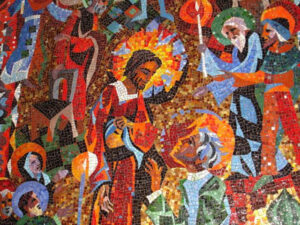
On the evening of Easter Day, the disciples are not radiant. They are not brave. They are not in the streets proclaiming good news. They are behind locked doors. That is where John wants us to find them: shut in, afraid, uncertain. The resurrection has already happened. Mary Magdalene has already said, “I have seen the Lord.”
And still, here they are—locked away. It is, in other words, a recognizable church. A church in fear. A church in retreat. A church trying to protect itself. A church that still does not know what resurrection demands. And into that frightened room, Jesus comes. Not because the disciples are ready. Not because their faith is impressive. Not because they have found courage at last. He comes because that is what the risen Christ does. He comes into locked rooms. He comes into frightened communities. He comes into hearts and churches that have shut themselves in.
Fear does not keep him out. Failure does not keep him out. Even unbelief does not keep him out. And his first word is not condemnation. His first word is peace. “Peace be with you.” Not the peace of avoidance. Not the peace of silence. Not the peace of “stay out of trouble.” And certainly not the peace of empire—the false peace built by threat, enforced by violence, and purchased at the expense of the vulnerable.
This is the peace of the crucified and risen Christ: a peace that has passed through death and come out alive. A peace that does not hide wounds but reveals them. A peace that does not deny suffering but overthrows its final claim. A peace that is not mere calm, but wholeness. Justice. New creation.
Then Jesus shows them his hands and his side. The risen Christ still bears the wounds. That matters. Because resurrection is not denial. It is not spiritual amnesia. It is not a polished religious story meant to distract us from the brutality of the world. Jesus does not rise untouched. He rises wounded and alive. And that is hope for us. Because we know about wounds. Some are personal: grief, betrayal, loss, shame. Some are communal: cruelty baptized as policy, lies dressed up as truth, neighbors abandoned, the vulnerable treated as expendable, a church that too often has preferred respectability to discipleship.
Resurrection does not mean those wounds were nothing. It means they are not sovereign. It means they do not get the last word. It means death does not get to name reality anymore. Then John tells us that the disciples rejoice when they see the Lord. Of course they do. Fear gives way to joy. Absence gives way to presence. Despair gives way to hope.
But Jesus is not finished. He says again, “Peace be with you.” And then immediately: “As the Father has sent me, so I send you.” That is the turn. The disciples want safety. Jesus gives them vocation. They want protection. Jesus gives them mission. They want a secure room. Jesus opens a door.
Resurrection turns disciples into apostles. A disciple is one who follows. An apostle is one who is sent. Jesus does not enter that room to make the disciples feel safer inside it. He enters that room to send them out of it. That is still what Easter means. The church does not receive Easter as comfort alone. The church receives Easter as commission. And that is a hard word, because churches can become very skilled at self-preservation.
We know how to maintain. We know how to protect. We know how to survive. And there is value in that. Tradition matters. Stewardship matters. Stability matters. But preservation is not the Gospel. The church was not raised up to admire its own endurance. The church was raised up to bear witness to the living Christ in a suffering world.
So, the real Easter question is not simply how to keep the church going. The real Easter question is whether we are willing to become the kind of people through whom resurrection can be seen. Will we remain barricaded by fear? Will we keep confusing caution with faithfulness? Will we keep calling self-protection wisdom? Will we keep speaking of peace while avoiding the costly work of mercy, truth, justice, and repair?
Because a church can say “Alleluia” and still keep the doors locked. A church can proclaim resurrection and still live as though fear is lord. A church can honor Jesus with its lips and still refuse his mission. But the risen Christ will not be contained by our caution. He breathes the Holy Spirit on the disciples and says, “Receive the Holy Spirit.” This is the language of new creation.
Just as God breathed life into the first human being, now Christ breathes new life into this fear-stricken community. They are being remade. And what is this Spirit for? For mission. For forgiveness. For peacemaking. For truth-telling. For continuing the ministry of Jesus in the world as it is.
And the world as it is is still wounded. It is a world where loneliness spreads. A world where cruelty is rewarded. A world where public life is shaped by outrage, contempt, and fear. A world where the vulnerable are pushed aside. A world where many have stopped expecting anything genuinely new. Into that world Christ sends his church. Not to dominate. Not to control. Not to win. But to bear witness to his forgiving, liberating, transforming love.
Parker Palmer once said, “The mission of the church is to love the world as Jesus did.” That is beautifully simple. And it is devastatingly demanding. Because Jesus loved the world publicly. Concretely. At cost to himself. He crossed boundaries. He touched the wounded. He told the truth. He confronted the powers. He welcomed the excluded. He refused to let holiness become an excuse for distance.
And now he says, “As the Father has sent me, so I send you.” Not somebody else. You. Us. That sending will look different in every place. But surely it means this: our parish life cannot end at the church door.
The peace of Christ is not meant to remain inside the sanctuary. It is meant to move through us into neighborhoods, schools, hospital rooms, public meetings, strained households, hungry places, and broken systems. A sent church is one that asks, day by day: where is Christ already at work among the wounded, the burdened, the overlooked, the threatened—and how do we join him there?
The disciples do not become fearless overnight. The church does not become pure overnight. And we will not either. But the risen Christ keeps coming. Keeps speaking peace. Keeps breathing Spirit. Keeps sending. Keeps making apostles out of frightened disciples.
And that is good news, because many of us are still somewhere in that room. Some of us are afraid. Some of us are tired. Some of us are carrying private doubts. Some of us want to believe, but do not want easy answers. And Jesus comes anyway. He comes through locked doors. He comes with wounded hands. He comes speaking peace. He comes breathing Spirit. He comes not only to comfort us, but to summon us.
So perhaps the question for this Second Sunday of Easter is not whether we are brave enough to become a sent church. Perhaps the question is whether we are willing to let the risen Christ interrupt us, unseal us, unsettle us, and send us where we would not have gone on our own.
Because the church is never more itself than when it is turned outward in love.
Christ is risen. And therefore the church cannot remain barricaded. Christ is risen. And therefore peace cannot remain private. Christ is risen. And therefore fear cannot be our master. Christ is risen. And therefore disciples must become apostles. May the risen Lord stand among us. May he rebuke our fear without crushing us. May he breathe his Spirit into our common life. And may he send us out—not merely to keep church, but to be the Body of Christ for the life of the world.
Amen.