Abraham is the father of three great religious traditions.
We know him as the faithful man who, at the age of 75, answered God’s call to leave his native land and to journey with his wife to a place he had never seen.
We know him as the man who became a father long after he and Sarah had given up any reasonable hope of having a child.
We know him as a man of great faith.
And indeed, he was.
But Abraham, like every human being, had other sides as well.
He is also the man who lied about Sarah’s identity to Pharaoh in order to save his own life.
And he is the man who drove his first son, Ishmael, and his mother, Hagar, into the wilderness.
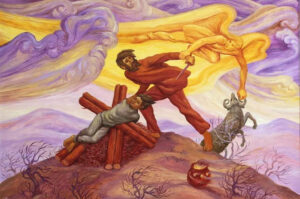
And today we hear the story of Abraham’s near-sacrifice of his younger son, Isaac.
Isaac, the child born Sarah in her old age.
Isaac, through whom God had promised that Abraham would become the ancestor of nations.
I will be honest with you.
I find the story of the binding of Isaac deeply disturbing.
On the surface, it appears to describe a terrible God who asks a father to be willing to kill his son in order for the father to prove his faithfulness to God.
This is certainly what the writer of this story seemed to think.
In verse 22:1 it says, “After these things God tested Abraham,” and then in verse 22:15 God says, “Because you have done this, and have not withheld your son, your only son, I will indeed bless you.”
We can understand, then, why so many people over the centuries have interpreted this story as being about faith and sacrifice.
Many people have read this story and said to themselves, “This is a story about being willing to sacrifice anything and everything for God.”
But I must be frank with you: that interpretation is a stumbling block for me.
I don’t believe that God asks or would ever ask anyone to sacrifice a child as a proof of faith.
Such an interpretation presents God as abusive, and I don’t believe that God is abusive.
Others have suggested that we shouldn’t focus too much on Isaac as we read this story.
Isaac, they say represents God’s promise.
Abraham, being full of faith, was willing to trust that God would find a way to fulfill his promise, no matter what happens.
But I can’t look past Isaac.
I can’t look past the undeniable fact that this story involves a father preparing to kill his child because he believes God has commanded him to do so.
I cannot look beyond the terror of an innocent boy bound upon an altar, with his father standing over him holding a knife.
Still others understand this story as reflecting a transformation happening within the life of ancient Israel.
There is evidence in the biblical and archeological record that child sacrifice was practiced at some points in Israelite history.
Eventually, Israel came to reject that practice.
Perhaps this story marks the moment when an animal is substituted for a child and human sacrifice is rejected once and for all.
Maybe.
But even then, I remain troubled by the fact that Abraham doesn’t seem to come to the idea of sacrificing his son on his own.
The story says that God tells him to do it.
And finally, many Christians have interpreted this story is foreshadowing the story of Jesus: Abraham is willing to sacrifice his beloved son just as God is willing to sacrifice His only son.
It is an allegory of the Christian story.
But you see, I don’t think God sacrificed Jesus in order to satisfy some divine need for violence or retribution.
I believe God sent Jesus into the world to show us what divine love looks like when it takes on human flesh.
Jesus healed the sick, welcomed the outcast, forgave sinners, challenged the powerful, and proclaimed release to the oppressed.
And the world killed him because the world was threatened by that love.
So, this morning, I want to offer you another possibility.
It is not original to me.
Others have suggested it, including Madeleine L’Engle, the great writer and Episcopal lay woman.
What if this is not primarily a story about faithfulness?
What if it is instead a story about sin?
What if it describes a world that has lost its way and lost touch with God?
Maybe Abraham did not pass the test after all?
What if God wanted Abraham to stand up and say “No! I will not kill my son!
I will not participate in the death of another human being!
I will not believe that the God of life requires the blood of a child!”?
What if Abraham failed the test because he did not say no?
After all, Abraham has repeatedly failed to protect the members of his own family while pursuing his destiny and preserving his own safety.
First, he places Sarah in danger in Pharaoh’s household in order to protect himself.
Next, he sends Hagar and Ishmael into the wilderness in order to placate Sarah’s jealousy, a jealousy that Abraham himself helped to create.
Maybe this story is about God giving Abraham one more chance to become the person God knows he can be: a person who protects the vulnerable, cherishes his family, and chooses life rather than death.
And once again, Abraham fails.
But Abraham’s failure is not the end of the story.
In Jewish tradition, the ram has long held an important place in the interpretation of this passage.
The ram reminds us that, in the end, Isaac is spared.
Violence does not have the final word.
Death does not have the final word.
Every year on Rosh Hashanah, the shofar, the ram’s horn, is blown.
Its cry calls the people to repentance and remembrance.
It recalls God’s mercy, God’s covenant, and God’s faithfulness.
Perhaps the ram’s horn reminds us that whatever Abraham believed God was asking him to do, God did not permit the knife to fall.
And isn’t something similar true for Christians?
We don’t stop at Good Friday.
We don’t linger there.
Good Friday is a key part of our story, but it is not the most important part.
The decisive moment in the Christian story is not when Jesus is nailed to the cross.
The decisive moment in our story is when God raises Jesus from death into new life.
The decisive moment is Easter morning when God defeats death, exposes the power of sin, and declares that the ways of divine love are stronger than the violence of the world.
What if the test in today’s story was not a test of Abraham’s willingness to surrender everything to God, but instead is a test of Abraham’s willingness to love another human being?
What if Abraham did not pass the test, but instead failed it?
And what if God then did what God always does and redeemed Abraham?
What if the Good News of this story is that in spite of Abraham’s failure and his sin, God loved him anyway and still made him the father of many nations.
The Good News is that in the face of Abraham’s failure God does not abandon him.
God continues to love him.
God remains faithful to His covenant.
For me, this is an interpretation of this story that I can not only live with but can also learn and grow from.
We too fall down.
Like Abraham, we also fail those we love.
Like Abraham, we often harm others in our attempt to protect ourselves.
And, like Abraham, God loves us anyway.
This is Good News.
This is a story of God’s love. Amen.