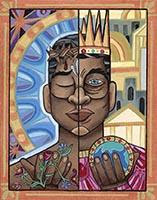
“The kingdom of heaven is like…” Again and again, Jesus begins with those words. The kingdom of heaven is like a mustard seed. The kingdom of heaven is like yeast hidden in flour. The kingdom of heaven is like treasure buried in a field. The kingdom of heaven is like a merchant searching for fine pearls. The kingdom of heaven is like a net thrown into the sea. Jesus keeps reaching for images because the kingdom of heaven is too large, too strange, and too wonderful to be contained in a single definition. One image will not do. So, Jesus takes us into the garden, then into the kitchen, then into the marketplace, and finally out onto the water.
And when Jesus speaks about the kingdom of heaven, he does not describe clouds or harps or pearly gates. He does not give us a map of the afterlife. Instead, he speaks of seeds and soil, bread rising in a village oven, fields, work, food, risk, joy, and transformation. The kingdom of heaven, as Jesus describes it, is remarkably earthy.
Much of Christianity has trained us to think of the kingdom of heaven primarily as a destination: the place faithful people hope to enter after death. The promise of the gospel is sometimes reduced to a promise that if we believe the right things now, we will go somewhere better later. But that is not how Jesus usually speaks about the kingdom. For Jesus, the kingdom of heaven is not simply a place to which we go. It is the reign of God breaking into the world. It is God’s life taking root in our life. It is God’s dream interrupting the arrangements we have come to accept as inevitable. It is already among us, although it is not yet complete. It is present, although it is often hidden. It is coming, although it has already begun.
The kingdom of heaven is like a mustard seed, Jesus says. It begins as something so small that it might be overlooked. It disappears into the earth. For a while, nothing seems to be happening. But beneath the surface, the seed is opening. Roots reach downward. A shoot presses upward. What looks insignificant becomes shelter. The birds come and make their nests in its branches. The kingdom does not grow merely for its own sake. It creates room. It offers shelter. It becomes home for creatures that did not plant it and could never have grown it for themselves.
That is one way we recognize the kingdom of heaven: it makes room for life. It makes room for the person who has been told there is no place for them. It makes room for the refugee and the stranger. It makes room for the poor. It makes room for the queer child who has been taught that God could not possibly delight in them. It makes room for those whose bodies, stories, cultures, or families have too often been treated as problems to solve rather than gifts to receive.
The kingdoms of this world create boundaries to protect privilege. They decide who belongs and who does not, whose life is valuable, whose pain is worth noticing, and whose hunger can be ignored. But God’s kingdom grows branches. God’s kingdom makes room.
Then Jesus says that the kingdom of heaven is like yeast that a woman hides in three measures of flour. The kingdom is concealed within the ordinary substance of life. And the woman places the leaven in an enormous quantity of flour—enough to make bread for a whole village. Far more bread than she could eat by herself. Far more than one household would need. This is not a parable about private spiritual fulfillment. It is a parable of abundance. The kingdom of heaven is present at the communal oven when everyone has enough to eat.
Perhaps that is as good a definition of God’s dream as any: everyone has enough, and there is room for everyone at the table. Not some people having far more than they could ever use while others go hungry. Not a world in which housing, medicine, education, and safety are treated as rewards for the fortunate. Not a society that measures human worth by productivity, wealth, citizenship, or status. God’s dream is bread in abundance. God’s dream is a table with no one missing. God’s dream is a community in which the flourishing of one person does not require the suffering of another.
We have sometimes confused the economic systems we have inherited with the kingdom of heaven. We may speak as though competition, accumulation, and endless growth were eternal laws written into creation itself. But capitalism is not the kingdom of God. No human system is the kingdom of God. Every human system must be judged by the vision Jesus gives us. Does it feed the hungry? Does it shelter the vulnerable? Does it honor the dignity of every human being? Does it create room at the table? Does it enable the earth and its creatures to flourish?
When a system produces extraordinary wealth but leaves children hungry, it is not the kingdom of heaven. When a system rewards exploitation and calls it success, it is not the kingdom of heaven. When a system tells us that some lives are disposable, it is not the kingdom of heaven. The kingdom is like yeast working through the whole mass of dough. It is not content to remain safely contained in the religious corner of our lives. It works its way into our relationships, our politics, our spending, our institutions, and our understanding of what we owe one another.
And yeast is not dramatic. For a while, it may seem that nothing is changing. That can be discouraging. We work for justice, and injustice remains. We tell the truth and lies appear to prosper. We practice compassion, and cruelty still commands attention. But Jesus tells us not to confuse hiddenness with absence. The kingdom is working even when we cannot see it. Every act of mercy matters. Every meal shared matters. Every child protected matters. Every unjust structure challenged matters. Every time someone refuses to return hatred for hatred, something is rising. Every time a community decides that no one will be abandoned, something is rising. The dough is being transformed.
Then Jesus turns to treasure and pearls. A man finds treasure hidden in a field. In his joy, he sells everything he has and buys the field. A merchant searching for fine pearls discovers one of extraordinary value. He sells everything and buys it. These are not cautious investors carefully diversifying their portfolios. These people reorganize their entire lives around what they have found. They have discovered something so valuable that everything else must be reconsidered. And here the parables become uncomfortable, because Jesus is no longer simply reassuring us that the kingdom is growing. He is asking us what we are prepared to do about it. Are we all in? If God’s dream is truly the treasure, what are we willing to release in order to live within it? What habits must we surrender? What privileges must we question? What securities must we loosen our grip upon?
The merchant does not simply add the pearl to his inventory. He sells the inventory. The discovery changes his identity. The kingdom of heaven is not one more item to fit into an already crowded life. It is not a spiritual accessory. It calls the whole arrangement into question. Jesus asks us to choose between the kingdoms of this world and the kingdom of God. The kingdoms of this world tell us to protect what is ours. The kingdom of God tells us that everything is gift. The kingdoms of this world tell us there is not enough. The kingdom of God prepares bread for the whole village. The kingdoms of this world tell us to fear the stranger. The kingdom of God grows branches where strangers can make a home. The kingdoms of this world tell us that power means domination. The kingdom of God reveals power in service, vulnerability, forgiveness, and love.
And this choice is not made once. It is made every day. It is made in how we use our money. It is made in how we vote. It is made in how we speak about people whose lives are different from ours. It is made in what we tolerate, what we resist, what we forgive, and what we repair. At the end of these parables, Jesus asks the disciples, “Have you understood all this?” They answer, “Yes.” I am not sure they understood. I am not sure we do either. But perhaps understanding a parable does not mean explaining it perfectly. Perhaps it means allowing it to work on us: letting the seed be planted, letting the yeast spread, letting the treasure reorder our desires.
Soon we will gather at this table. Here, we receive a glimpse of the kingdom Jesus proclaimed. There is enough. No one comes because they have earned a place. No one is seated according to status. We come with empty hands. We receive the same bread. We drink from the same cup. And then we are sent out to become what we have received: the Body of Christ, bread for a hungry world. The kingdom of heaven is already breaking in. It may begin with something as small as a seed. It may be hidden in an ordinary act of courage. It may rise quietly in a community that decides to make room. It may appear wherever the hungry are fed, the excluded are welcomed, the wounded are tended, and the powerful are called to account. It is among us. It is within us. It is still coming. And it is worth everything. So let us seek it. Let us choose it. Let us make room for it. And let us live as though the bread is already rising. Amen.