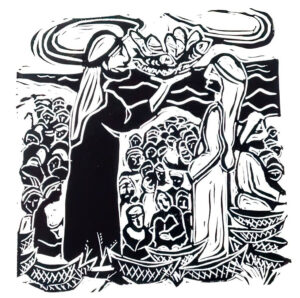
Today’s Gospel begins with Jesus trying to get away. Matthew tells us that Jesus withdrew by boat to a deserted place. He had just learned that John the Baptist had been murdered by Herod. John—Jesus’ cousin, teacher, baptizer, and fellow prophet—had been executed because he dared to speak truth to power.
Jesus must have been grieving. He may also have been afraid. John’s death was a warning. Empires do not take kindly to prophets who expose their cruelty. So, Jesus goes away, seeking silence, prayer, perhaps a little time to mourn.
But the crowds follow him. They come on foot from the surrounding towns: people who are sick, people who are hungry, people whose bodies bear the consequences of poverty and exploitation. They live in an empire in which a small number of people possess immense wealth, power, land, and food, while most live close to hunger. That inequality is considered normal. It is simply the way the world works. There is plenty at Herod’s palace. There is wine, food, music, entertainment, and excess. Yet that abundance is guarded for the privileged few. Herod’s banquet ends with John’s head carried into the room on a platter.
Then Matthew brings us to another banquet. This one takes place far from the palace, in a deserted place. Its guests are not rulers, military officers, or wealthy landowners. They are ordinary people. Poor people. Sick people. Women and children whose presence the official count does not even fully acknowledge. And when Jesus sees them, Matthew says, “he had compassion for them.”
The word translated as “compassion” describes something physical. Jesus feels their suffering in his gut. He is moved in the deepest part of his body. Jesus does not look at the crowd and see an inconvenience. He does not see a mass of irresponsible people who should have planned better. He does not ask whether they deserve help. He does not divide them into the worthy and the unworthy. He sees people who are suffering. And he is moved.
That is where the miracle begins. It begins not with the bread, but with compassion. In an empire that has little compassion for suffering people, Jesus is moved by their pain. In a society that treats hunger and sickness as normal, Jesus refuses to accept either as inevitable. He heals their sick.
And when evening comes, the disciples approach Jesus with a reasonable suggestion: “This is a deserted place, and the hour is now late; send the crowds away so that they may go into the villages and buy food for themselves.” It is practical advice. There are too many people. There is not enough food. The disciples do the math and arrive at the obvious conclusion: send them away.
We know this arithmetic. We hear it all the time. There is not enough money to feed hungry children. There is not enough money to provide health care. There is not enough room to welcome the stranger. There are not enough resources to care for the elderly, house those who are homeless, or help families struggling to survive. Strangely, there always seems to be enough for weapons, prisons, tax advantages, corporate subsidies, and luxuries for those who already possess more than they could ever need. But when suffering people ask for bread, medicine, shelter, dignity, or welcome, suddenly we are told that resources are scarce.
The disciples look at the crowd through the lens of scarcity. Jesus looks at the same crowd through the abundance of God. “They need not go away,” Jesus says. “You give them something to eat.” You can almost hear the disciples sputtering. We cannot do that. We do not have enough. “We have nothing here,” they say, “but five loaves and two fish.” Nothing but.
Notice how scarcity speaks. Scarcity looks at what is present and calls it nothing. Five loaves. Two fish. Human hands. A community gathered. The compassion of Christ. The generosity of God. Scarcity says: nothing. Jesus says: “Bring them here to me.” Jesus takes the bread, blesses it, breaks it, and gives it to the disciples. The disciples give it to the crowds. Everyone eats. Everyone is filled. And afterward, twelve baskets of broken pieces remain.
This is the only miracle of Jesus recorded in all four Gospels. The early church understood that this story was too important to lose. It revealed something essential about God and something essential about discipleship. God desires that hungry people be fed. And discipleship means participating in the feeding. Jesus does not create a private meal for himself and his closest friends. He does not distribute food only to those who can prove their need. He does not charge admission or require the crowd to demonstrate gratitude. He feeds them. All of them. Jesus shatters the assumption that some people having far too much and many having far too little is natural, necessary, or ordained by God. That may be the world according to empire. It is not the world according to God.
In the book, The Serviceberry, Robin Wall Kimmerer describes gathering berries that she did not plant, purchase, or earn. She receives them as a gift from the land. She writes that when we speak of the things that sustain us not as commodities or resources but as gifts, our relationship with the natural world changes. A gift awakens gratitude. And gratitude awakens reciprocity. When life is understood as gift, the question is no longer, “How much can I possess?” The question becomes, “How shall I respond?” How shall I honor what I have received? How shall I share it? How shall I give back?
Kimmerer observes that gifts come with responsibilities: sharing, respect, reciprocity, and gratitude. A gift is not something to seize and hoard. A gift moves. It circulates. It creates relationship. That is what happens in today’s Gospel. The bread moves from the earth to human hands, from human hands to Jesus, from Jesus to the disciples, and from the disciples to the crowd. It passes from hand to hand until everyone has enough.
Perhaps the miracle is that Jesus multiplies the food in a way no one can explain. Perhaps the miracle also includes frightened people opening their hands, sharing what they had hidden away, and discovering that generosity is more powerful than fear. Either way, the miracle reveals God’s economy. In the economy of empire, wealth travels upward and becomes concentrated in the hands of a few. In the economy of God, gifts circulate until everyone is fed.
Our world desperately needs this awakening. We inhabit a culture that trains us to believe we never have enough. We are encouraged to consume more, accumulate more, protect more, and fear that someone else might receive something we believe belongs to us. That fear shapes public policy. It shapes our neighborhoods, institutions, and budgets. It convinces us that compassion is naïve, generosity is dangerous, and suffering is simply the unavoidable price of economic life.
Meanwhile, the wealthy grow wealthier. Those who are poor are asked to survive with less. And the earth groans beneath the weight of our consumption. Forests, rivers, oceans, animals, soil, and atmosphere are treated not as sacred gifts but as commodities to be extracted, exhausted, and discarded. We consume as though nothing is enough. We hoard as though nothing is secure. We live by scarcity even while surrounded by gifts. Maybe we need Jesus to wake us up, just as he awakened the disciples.
“They need not go away.” The hungry do not need to disappear from our sight. The sick do not need to suffer because care is too costly. The refugee does not need to be treated as a threat. The poor do not need to be blamed for their poverty. The earth does not need to be sacrificed to satisfy our endless desire for more. “You give them something to eat.”
Jesus does not say that we must solve every problem alone. He asks us to bring what we have. Our bread. Our money. Our land. Our buildings. Our voices. Our votes. Our imaginations. Our willingness to organize, advocate, share, and sacrifice. Bring them here to me, Jesus says.
The church is not called merely to admire the miracle. We are called to participate in it. We rehearse that participation every time we gather at this table. Here, bread is taken, blessed, broken, and given. Here, no one earns a place. Here, we receive what we cannot purchase. Here, we discover that the holy gifts of God are given for the holy people of God—and that holiness is not private possession but shared life. At this table, Christ places God’s abundance into our open hands. Then Christ sends us out to become what we have received: bread for a hungry world, healing for a wounded world, compassion within a merciless world, and signs of another way of living together.
The empire says there is not enough. Jesus says, “Bring me what you have.” The empire says everyone must look after themselves. Jesus says, “You give them something to eat.” The empire hosts a feast for a few while the many go hungry. Jesus spreads a table in the wilderness, and everyone eats until they are filled. This is the world according to God. May Jesus awaken us to see it. May gratitude open our clenched hands. May compassion move us into action. And may God take what we offer, bless it, break it open, and multiply it—until everyone has enough and there are baskets left over. Amen.