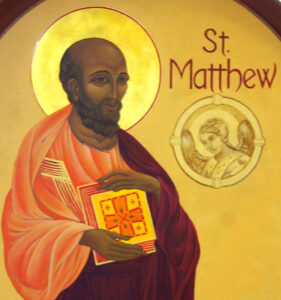
Jesus is walking along when he sees a man named Matthew sitting at the tax booth. That is how the story begins: with a man sitting. Matthew is not sitting in a neutral place. He is sitting at the tax booth, a place where money is taken, where empire reaches into ordinary households, where the power of Rome becomes personal. Every coin that passes across that table carries the weight of occupation. Every transaction reminds Matthew’s neighbors who has power and who does not. And Matthew is not merely a victim of that system. He is implicated in it. He profits from it. He has found a place for himself in a structure that wounds his own people.
So, when Jesus sees Matthew, Jesus sees a complicated person. Jesus does not see a symbol or a category. To Jesus, Matthew is not merely “tax collector,” “collaborator,” “sinner,” “traitor,” or “problem.” Jesus sees Matthew. All of him. His compromises, his wounds, his fear, his longing, his entanglement in a system bigger than himself. And Jesus says, “Follow me.”
And notice what Jesus does not say. He does not tell Matthew to “Fix yourself first.” He does not ask Matthew to, “Explain how you got here.” Jesus simply says: “Follow me.” And Matthew gets up and follows. That may be the first miracle in today’s Gospel. Before the healing of the woman. Before the raising of the little girl. Before the touch of Jesus restores bodies and futures, there is this quieter resurrection: a man gets up from the place where he has been stuck. He gets up and follows Jesus.
And then, almost immediately, everyone is sitting again. Jesus is sitting at dinner. Matthew is there. The disciples are there. Tax collectors and sinners are there. A whole crowd of people who do not belong together, according to the rules of respectable society, are together at a table. And this, apparently, is what causes the scandal.
The Pharisees ask, “Why does your teacher eat with tax collectors and sinners?” We should be careful here. The Pharisees are not cartoon villains. They are serious religious people trying to be faithful in a frightening world. They care about holiness. They care about Scripture. They care about the survival of their community under empire. In that sense, perhaps they are not so unlike us. They are trying to preserve what is good.
But Jesus says to them, and to us, “Go and learn what this means: ‘I desire mercy, not sacrifice.’” Go and learn. Learn mercy. Not mercy as sentiment or politeness. Not mercy as the softening of the Gospel into something vague and harmless. Mercy, in Matthew’s Gospel, is powerful. Mercy is embodied. Mercy sits at the table with the wrong people. Mercy touches the untouchable places. Mercy interrupts death. Mercy restores those who have been reduced to a diagnosis, a label, a political category, a threat, a burden, or a lost cause. Mercy is what God wants. And that is a word for this moment.
We are living in a time when many of us are afraid. Afraid for democracy. Afraid for the vulnerable. Afraid for women. Afraid for LGBTQ+ people, especially in this month of Pride. Afraid for immigrants, for people of color, for teachers and students, for the climate, for truth itself. Afraid of Christian nationalism and the way it takes the name of Jesus and uses it to bless domination. Afraid of violence abroad and violence at home. Afraid of what might happen next. And many of you are tired. Not apathetic. Not indifferent. Tired. And there is a difference.
Some of you have been working for justice longer than younger people have been alive. You have marched, written letters, served on committees, raised children, cared for neighbors, welcomed strangers, kept institutions alive, buried friends, endured illness, and still shown up on Sunday morning to pray for the world.
And now it can feel as if the old wineskins have burst. The old assumptions cannot hold. The old confidence that progress would simply continue, that democracy would hold, that decency would prevail, that the church would naturally be a force for good—those old containers are cracking. And into that cracked place comes Jesus, saying, “Follow me.” And where does Jesus go? He goes to the table. He goes to the sick. He goes to the girl everyone else has already begun to mourn. He goes to the woman who has been bleeding for twelve years.
On the way to one emergency, Jesus is interrupted by another. A leader comes to him because his daughter has died. A child is dead. The future has been cut off. Hope has left the room. And Jesus gets up and follows him. But then a woman reaches out and touches the fringe of his cloak. She has been suffering for twelve years. Twelve years is a long time to live with your body betraying you. Twelve years is a long time to seek help and still not be well. Twelve years is a long time to be tired.
She does not give a speech. She does not ask permission. She simply reaches for the smallest edge of hope she can find. “If I only touch his cloak,” she says to herself, “I will be made well.” And Jesus turns. That matters. Jesus is on his way to the house of an important man. A leader. A person with standing. A person whose grief would have been visible to the whole community. And yet Jesus stops for this woman. He sees her. As he saw Matthew, he sees her. And he says, “Take heart, daughter; your faith has made you well.”
Take heart. Be courageous. Be confident. Daughter. That one word gives her back more than health. It gives her belonging. She is not an interruption. She is not secondary. She is not less urgent because her suffering is chronic rather than sudden. She is family.
And then Jesus goes on to the house where the little girl lies dead. The mourners are already there. The flute players, the noise, the public rituals of grief. Everyone knows what death looks like. Everyone knows what is possible and what is not. Jesus says, “Go away; for the girl is not dead but sleeping.” And they laugh at him. Of course they do. Resurrection often sounds ridiculous before it becomes visible. Mercy often looks naive to those who have made peace with death. Hope sounds foolish in a room that has already surrendered to despair. But Jesus takes the girl by the hand, and she gets up.
There it is again. Matthew gets up from the tax booth. Jesus gets up to follow the grieving father. The little girl gets up from death. The Gospel is full of rising. And that is the invitation before us. Not to deny the danger of the hour. Not to pretend that everything is fine. Not to minimize the fear of those who are most at risk.
Christian hope is not denial. It is defiance. It is the holy refusal to let death have the final word. It is the decision, again and again, to get up. Get up and follow. Get up and make room at the table. Get up and vote and help others vote. Get up and protect the threatened. Get up and tell the truth. Get up and reach for the fringe of his garment when all you have left is a trembling hand and a thin thread of faith. And maybe, especially, get up from the need to be the righteous ones.
That may be the hardest call for us. Because we can see so clearly the cruelty in others. We can see the hypocrisy, the danger, the lies, the idolatry. And we are not wrong to name them. The Gospel does not ask us to call evil good. But Jesus also warns us against a righteousness that loses mercy. A righteousness that cannot sit at table. A righteousness that forgets that we, too, are entangled in systems that wound. A righteousness that imagines healing is only needed over there, among those people.
Jesus does not say, “I desire your correctness.” He says, “I desire mercy.” Mercy for the frightened. Mercy for the targeted. Mercy for the exhausted. Mercy for the people who have been told their bodies, their loves, their histories, or their questions make them unacceptable. Mercy even for the ones we cannot yet imagine welcoming—though mercy does not mean surrendering truth, excusing harm, or abandoning the vulnerable. Mercy is not passivity. Mercy is God’s fierce commitment to life.
That is what this parish is called to be in midcoast Maine, in Pride month, in election season, in a country many of us scarcely recognize: a community of fierce mercy. A place where no one is reduced to the worst thing they have done or the worst thing done to them. A place where women’s bodies matter, queer bodies matter, trans bodies matter, aging bodies matter, immigrant bodies matter, tired bodies matter, children’s bodies matter, black bodies matter. A place where those who are afraid can hear Jesus say, “Take heart, daughter. Take heart, son. Take heart, beloved child.” A place where we practice resurrection before we can prove it.
So come to the table. Come with your fear. Come with your anger. Come with your weariness. Come with your compromises. Come with your hope, however small. Jesus is here. The physician is here. Mercy is here. And Christ is still saying to his church: “Follow me.”
Amen.